- no passport and little money
Travel documents were not legally required for entering Hong Kong until 1923, and the requirement that was imposed in that year did not apply to “persons of the Chinese race.” A law allowing for Chinese people to be excluded if they lacked required documents was first passed in 1940, as the Japanese invasion of the mainland caused an enormous number of people to flee to Hong Kong; however, that law was not tightly enforced. (The influx of people was, however, ended by the Japanese occupation of Hong Kong in December, 1941; in fact it was reversed as huge numbers of people fled the city.) During the Chinese Civil War, refugees again arrived in huge numbers, with and without papers. After 1949, the British government tightened its enforcement of immigration rules considerably -- though at first there was an exception for people from Guangdong – and for the first time imposed universal registration requirements to stay in the city; Chinese control of exit also became much stricter, though it lapsed during certain moments of crisis, allowing for large scale immigration to Hong Kong in those years. Officially, Britain claimed the right to deport people who entered the city without proper documents (which for some categories of people included visas), but its willingness and ability to do so fluctuated over time, especially since the P.R.C. was not always willing to receive mainland citizens whom the British wished to deport. A 1971 reform strengthened the rights of those who had been in HK for at least 7 years (no matter how they had originally entered), while tightening enforcement against some other groups.
- various cities and lines of work
Members of Bard’s family and his wife’s family worked at various times at many trade including as jewelers, watch-makers, opticians, furriers, musicians and music teachers, doctors, pharmacists, bookkeepers, dance instructors, and timber merchants: members lived at various points in Warsaw, Moscow, Sebastopol, Chita, Beirut, Aleppo, Berlin, Harbin, Shanghai, Riga, Nice, London, New York, Buenos Aires, Tel Aviv, Melbourne, Sydney, and of course Hong Kong.
- Chita, an important railroad junction
Here’s a simple map showing where Chita is and its position on the Trans-Siberian RR, going in one direction back to Moscow and St. Petersburg, and in the other at the junction of two lines, one going across the rest of Russia to Vladivostok and one going southeast to Harbin, where it connected to the Chinese railway system.
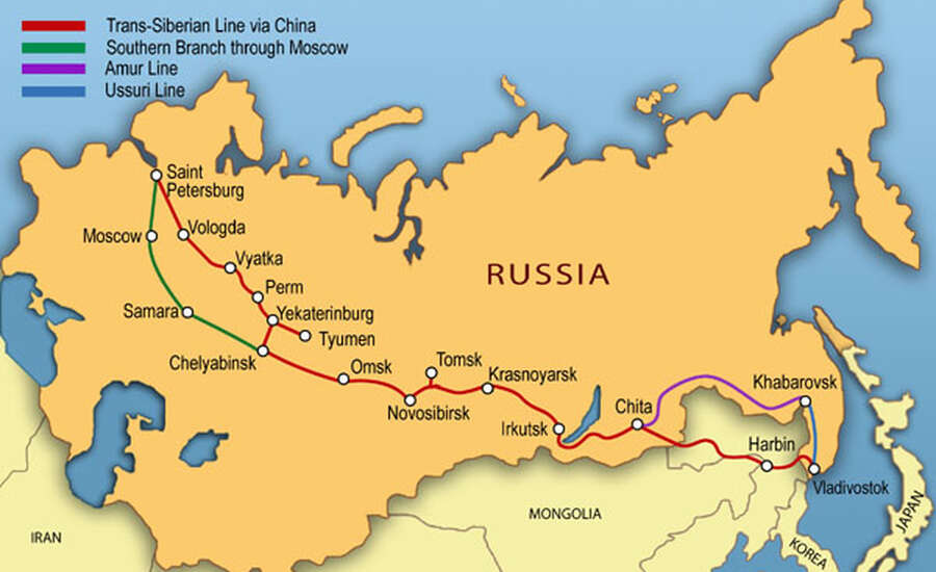
(Source: Trans-Siberian Express)
- Chinese Eastern Railway
Here’s a map showing the Chinese Eastern Railway as it existed in the early 20th century showing the crucial position of Harbin, the links to Russia, and the links to southern Manchuria, Beijing, etc. (The one thing that does not look the way it would have in that period is that whoever drew the map has put in the names of North Korea and South Korea, along with border between them. Until 1945 the peninsula was the Japanese colony of Korea, with non N/S border)
/Picture1.png)
(Source: Wikimedia Commons)

- Jewish / Zionist youth group
The Jewish population of Harbin was probably about 8,000 before World War I, and reached 15,000 or more in the 1920s. (The highest estimate is 25,000) Since Harbin probably had about 120,000 Russians at that time (some figures go as high as 200,000), Jews were a decided minority among the city’s Russians (not to mention its overall population of around 500,000), but not an insignificant one, and their relations with the rest of the Russian community were often tense. Many of the Russian exiles, especially the ex-soldiers – though certainly not all of them – belonged to the political far right. For various reasons, the Russian right wing had a very strong anti-Semitic element, which often portrayed Jews both as ruthless capitalists who had destroyed the Russian peasantry and as communists who were responsible for the excesses of the Soviet Union. Partly in response to this, and in an absence of legal protections for minorities in both pre- and post-revolutionary Russia, Zionism – the movement for a Jewish national homeland, usually imagined in what was then Palestine – was quite strong among Russian Jews in this period, both within Russia and in diaspora locations such as Harbin. Britain took control of Palestine (formerly ruled by the Ottomans) during World War I, and announced their support for some sort of Jewish homeland there (leaving the details vague); this further strengthened interest in Zionism among Jews in Harbin (and elsewhere), and Zionist youth groups became a major part of Jewish life in many places.
These groups varied considerably in their ideologies, and in their attitudes towards violence. The one that predominated in Harbin, called Betar (meaning “fortress”), came from the hardline, ultra-militant wing of Zionism. (it had been founded by Jews from Riga, which was then Russian-ruled; this may have given it particular credibility among the Russian Jewish exiles in Harbin.) Bard himself was a Zionist, and remained one throughout his life – he later wrote that when he eventually visited Israel years later, and met up with old friends from Harbin’s Betar he felt guilty about not having moved to Palestine when Japan took over Harbin, as they had. But he favored a much more moderate Zionism than Betar’s, much less willing to support violence. In fact, in an unpublished family history Bard wrote late in his life (2007), he referred to Betar as resembling “brownshirts”: the paramilitary shock troops of the early Nazi movement, also a product of this period. His disillusionment with Betar had important implications for his subsequent life, as some of his friends who remained active in the group chose to emigrate to British Palestine (later Israel) when things got ugly under the Japanese in the 1930s – while Bard instead went to Shanghai and then Hong Kong.
It is unclear how important Betar was to the Jewish community in Harbin, or how many people who had some association with it supported its entire program. A history of the Harbin Jewish community by one enthusiastic ex-member credits the group with protecting people against the White Russians, as well as organizing many social and cultural activities; Bard mentions sports teams and outings sponsored by Betar, but otherwise says little about it, and refers to violence only in the context of “boys” getting involved in “street brawls.” There is no doubt, though, that it organized many other activities – from sports teams to summer camps, nature hikes, and music programs, and was often the only group sponsoring such activities for Jews in Harbin; Bard participated in many of these activities while growing up there.
- uncle David
Bard’s maternal uncle, David Froumson, was a major influence on him. Among other things he introduced him to the violin, and to playing in orchestras; but he also helped convince Bard not to pursue music as a career. Froumson’s own career helps explain why.
David was born in Sebastopol in 1897, where his father and mother (Bard’s grandparents) were furriers; his father also gave music lessons (on violin and flute) and dance lessons to supplement his income. David played the violin but did not originally plan to make it his career.
Fate intervened as David was conscripted into the Russian army before he had a chance to fully learn any trade. Escaping from that, he was back in Sebastopol when the Red Army approached during the Russian Civil War, and it seemed likely that he would be conscripted again, He and his brother fled on the first boat they could get on, which happened to be a Greek warship headed for the Middle East. Disembarking, David found that his most marketable skill was his violin-playing; from 1923-26, he made his living playing in night clubs in Aleppo and Beirut. In 1926, his sister (Bard’s mother) with most of her family now settled in Harbin, sent for David, and he joined the family there.
Bard’s mother disapproved of he brother making his living in night clubs, feeling that this was not fully respectable and also involved hours that were hard to reconcile with having a family. It appears that David himself had doubts, too, but the violin remained his best way of making a living; many Harbin clubs and restaurants had live music, and there was also a “serious” orchestra that David joined. Solly asked him to teach him to play, too, and he turned out to have a knack for it; more music lessons followed, and before long the younger Bard began joining his uncle for some performances.
But David opposed the idea of Solly becoming a professional musician. Apparently, he himself wished that he had a different career -- and he eventually did. Moreover, he told Solly that while he was a very good musician, he was not quite good enough to make a good living as a headline performer. Meanwhile, playing in a band or orchestra was an economically precarious path, and David thought it was about to get much more so: movies with sound (“talkies”) were just taking off, and as they took over, jobs playing in movie house orchestras, accompanying silent films, would vanish. Whatever the exact mix of arguments was – Bard himself gave slightly different accounts on various later occasions – Solly was convinced, and headed for Shanghai to work on English and prepare for medical school. Uncle David went, too, but he continued to work as a musician there: first in the orchestras of nightclubs (some of them Russian-owned and/or themed), where he was again sometimes joined by Solly, and then in the Shanghai Municipal Orchestra.
By 1948, David and his nephew Leo (Bard’s brother) were still in Shanghai, having survived the war; but they were uncertain about what would come next. CCP forces were fast approaching the city, and it was unclear how they would treat either the foreigner-dominated Municipal Orchestra or Leo’s optical business. Still having no passport from any country – the International Settlement in Shanghai, where they had been since 1932, neither required them nor could issue them – they had few options; one was the newly-formed nation of Israel, which would grant entry to any Jew. Both Leo and David moved there; Leo opened an optician’s business, and David, helping him, learned enough to open a shop of his own when Leo, who had never liked living in Israel, moved on to Argentina (where his parents still lived) a few years later. He was apparently pleased to no longer depend on music for a living, as he had for over 25 years. Eventually David moved, too, following his married daughter to Melbourne, Australia.
- the Japanese has seized Manchuria
/Picture2.jpg)
(Source: S.C.M. Paine; The Wars for Asia, 1911-1949)
- scattered in many directions
Some Harbin Russians went to the Soviet Union, which generally did not work out: many were killed either in Stalin’s purges or in WW II. Some went to the Americas, both North and South; some to Shanghai or other places in China; some of Bard’s friends from the Jewish community went to Palestine. Quite a few, like Bard, wound up in Hong Kong as well; Bard played violin at least one public benefit concert for Russian refugees.
- Bard’s first mention in the Hong Kong press
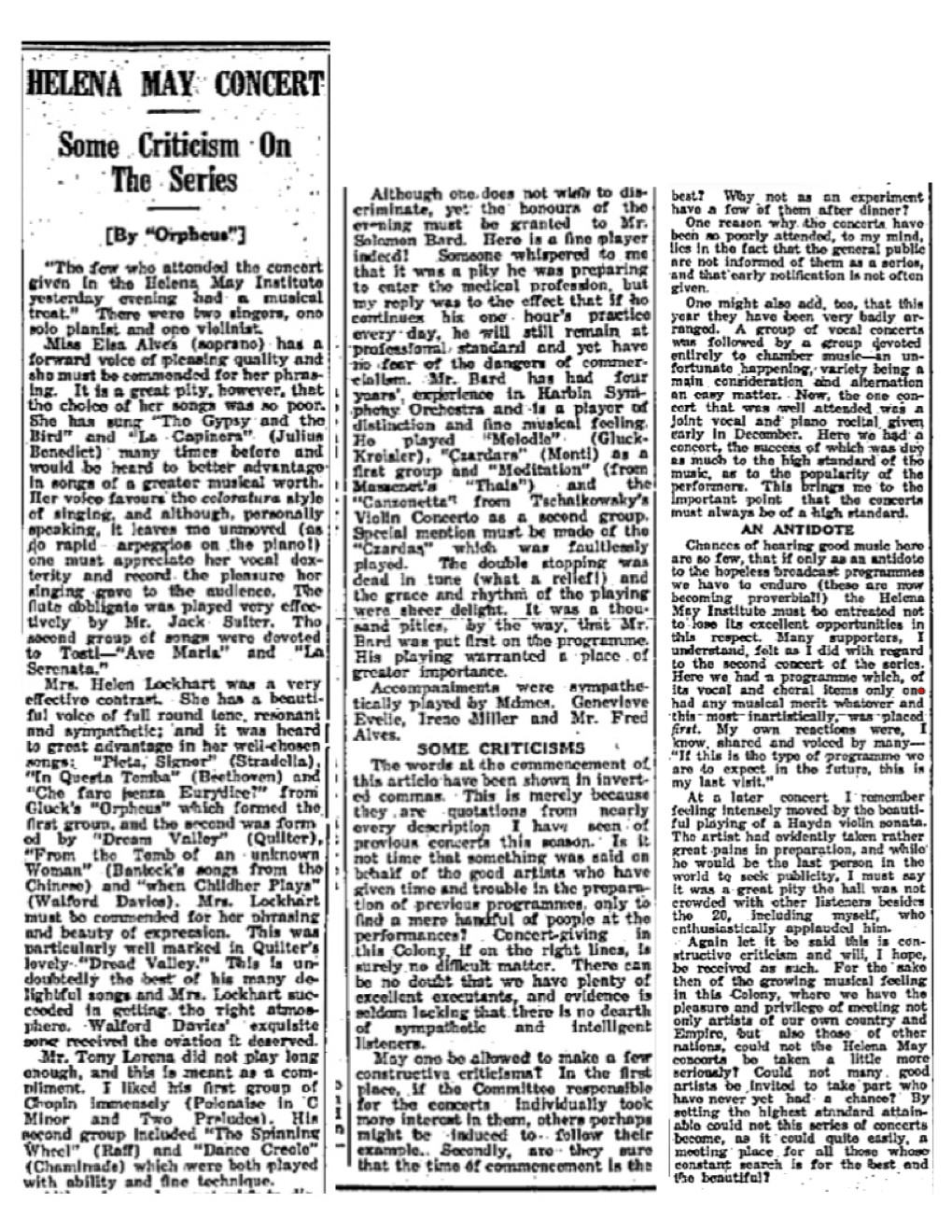
(Source: Helena May Concert HK Telegraph, March 21,1936)
- Japan attacked on December 8, 1941
Japan’s invasion and the sacrifice of Hong Kong:
By 1930, Japan had become East Asia’s strongest power, and increasingly expansionist. The nations that might have deterred Japan – the UK, US, USSR, and China – were all suspicious of each other, had other priorities competing for their physical, financial, and human resources of all sorts, and did not cooperate effectively until war was well underway.
The London Naval Treaty, which limited both ships and coastal defence installations in East Asia, lapsed in 1936. In response, Britain quickly began building nine batteries on Hong Kong Island, including the Jubilee Battery on the site of this campus. However, Hong Kong remained very vulnerable, especially from the air; the British had only 5 military planes in the area, based at a small, vulnerable, landing strip at Kai Tak, while Japan had multiple air bases within flying distance of the city.
Japan started its attack on the 8th December 1941, taking the New Territories and Kowloon quickly; the defenders were evacuated on the 11th December through the 13th December. On the 18th December, Japan attacked Hong Kong Island. As Japanese troops advanced, the guns of Mount Davis Battery turned eastward and fired across Hong Kong Island. The island’s defenders were outnumbered by the Japanese invaders roughly 15,000 to 37,000, and lacked air support; they resisted longer than the Japanese had expected, but surrendered on the 25th December. The defenders had known from the beginning that their forces were inadequate, but there were many rumors (which were untrue, but encouraged by some British authorities) that if they could hold on a while, they would be relieved by Nationalist Chinese forces headed towards them from Guangdong, British forces arriving by sea, or some combination thereof.
Over 10,000 defenders were captured; about 2,000 died, along with 4,000 civilians and 675 Japanese. A brutal occupation began, lasting until 1945. The city’s population fell by almost half, and by one estimate, by the war’s end, 80% of Hong Kongers had been affected by malnutrition.
The odds against holding Hong Kong had been so high that some people question whether the British should have tried to defend it; evacuating troops and surrendering the city would have saved lives. Others, however, argue that immediate surrender might have weakened the resolve of China (which had been fighting Japan since 1937), and undermined anti-Japanese cooperation with the US. In this view, though Hong Kong’s defenders could not protect the city, their sacrifice served a larger purpose.
- bombed it heavily
Aerial view of the Japanese bombing of Mt Davis, showing explosions all over: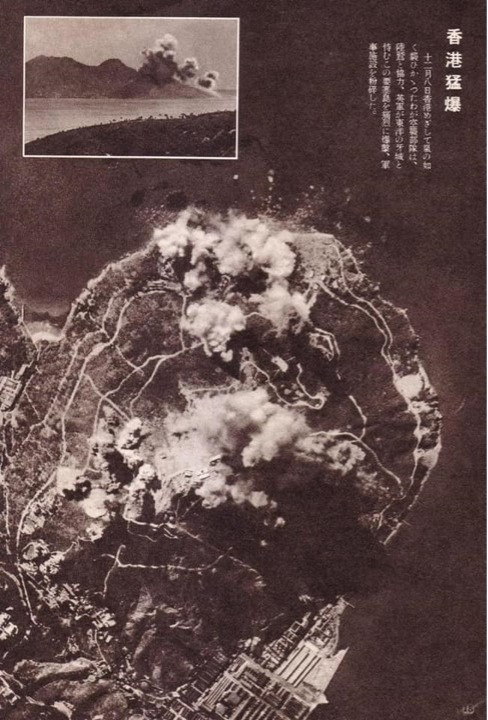
(Source: Kwong, C.M. (2021). The Battle of Hong Kong 1941: A Spatial History Project. Retrieved October 1, 2024, from Hong Kong Baptist University Library, History in Data: https://digital.lib.hkbu.edu.hk/1941hkbattle/)
Bard’s makeshift operating area:
A British photo of some buildings at the Jubilee Battery, now the site of our campus, taken just before the war, in 1941. It is very close to where Bard was the second time he almost got killed.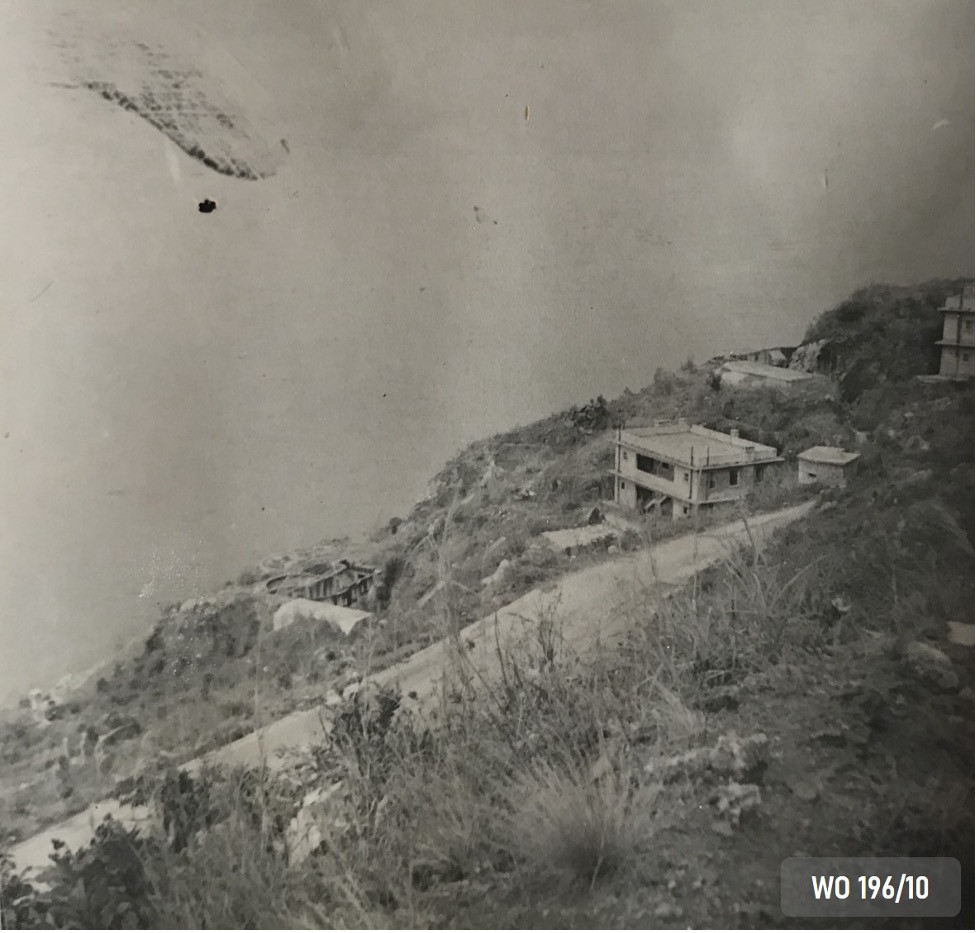
(Source: Kwong, C.M. (2021). The Battle of Hong Kong 1941: A Spatial History Project. Retrieved October 1, 2024, from Hong Kong Baptist University Library, History in Data: https://digital.lib.hkbu.edu.hk/1941hkbattle/)
- was almost killed on two occasions
One of these incidents occurred on top of Mt. Davis. There was a 9.2” diameter gun that could propel a shell over 20 miles in any direction, making it particularly important, and the Japanese bombed and shelled the site heavily. (Since the Japanese were approaching from the mainland, rather than from the sea, the guns lower down the mountain, which pointed out to sea, were not very important.) Bard had a makeshift clinic in a stone bunker there and also in a plywood hut that had once been used as a signaling station; it was flimsy and exposed, but near the action, and equipped with a telephone. Bard and some assistants did triage in the bunker, provided care to those who needed it immediately, and sent others down the mountain to the Jubilee Battery (part of which is now this campus) for further treatment. At one point, a Japanese artillery shell tore through the wall of this clinic, but it did not explode. If it had, Bard and the roughly 60 patients in the room would all have had a high risk of death.
The other occurred across Victoria Road from this campus, near the secondary treatment site at Jubilee Battery. Bard, who was taking a break after checking patients there, was caught in a bombardment, and took shelter in the basement of an empty building at Felix Villas (now owned by HKU), where he was joined by a terrified stray dog. As he described it later, he then suddenly had a bad feeling about the place, grabbed the dog and ran out; seconds later, the basement was hit by a shell and collapsed.
- another prisoner’s exceptional bravery
Click to watch interview of Jason Wordie:/WhatsApp Image 2024-09-25 at 21.44.32.jpeg)
- Arrigo Foa
Arrigo Foa (1900-1981) was born near Milan and was an exceptionally gifted young violinst, entering the Milan conservatory at age 12. In 1921, he was recruited to join the Shanghai Municipal Orchestra by its conductor, also an Italian. He wound up marrying a Wuhan-born Italian woman who worked as a translator at the Italian consulate, and the couple settled in Shanghai. By the time Japan occupied the foreign concessions in Shanghai, Foa had become the orchestra’s assistant conductor, and took over when the then-conductor (the man who had recruited him) chose this occasion to retire. Foa also taught at the Shanghai Conservatory of Music: in both settings, he mentored and sponsored a number of Chinese musicians at a time when many other foreigners rarely did so. (One student he turned down was Nie Er, who later composed the P.R.C.’s national anthem – originally as part of the score for a movie celebrating the resistance against Japan’s seizure of Manchuria.)
Foa and the Shanghai Municipal Orchestra survived WW II largely intact. (Italy was theoretically an ally of Japan, which may have helped, but a bigger factor was probably Foa’s willingness to share the conductor’s platform with some Japanese guest conductors, perform some Japanese music, and incorporate more non-European musicians.) However, they had more trouble navigating the coming of the Revolution. Many musicians left (including Bard’s uncle David), but Foa stayed on, and did what he could to show a cooperative attitude; the orchestra played benefit concerts for the poor, performed new works by Chinese composers, and recruited more Chinese musicians; once China entered the Korean War in 1950, it also performed fund-raising concerts for the war effort. But in 1952, he was dismissed from his position at the Conservatory, and then from the Orchestra as well; no explanation was given, though one person was told that this was part of a campaign against “foreign colonizers.” In 1953, Foa was recruited as conductor of what was then still the Sino-British Orchestra, but would soon become the Hong Kong Philharmonic; Bard played a major role in the recruitment.
Foa remained with the Hong Kong Philharmonic until 1969, presiding over its increasing professionalization, its move to City Hall, and its growing international stature. He died in 1981, and is buried in the Jewish Cemetery at Happy Valley.
- a professional orchestra would need broader support
Bard calls for orchestra in China Mail 1948: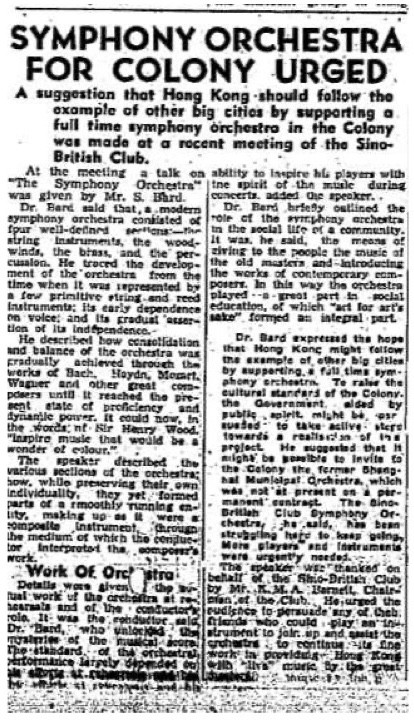
(Source: China Mail, 1948.)
- Hong Kong newspapers across the political spectrum
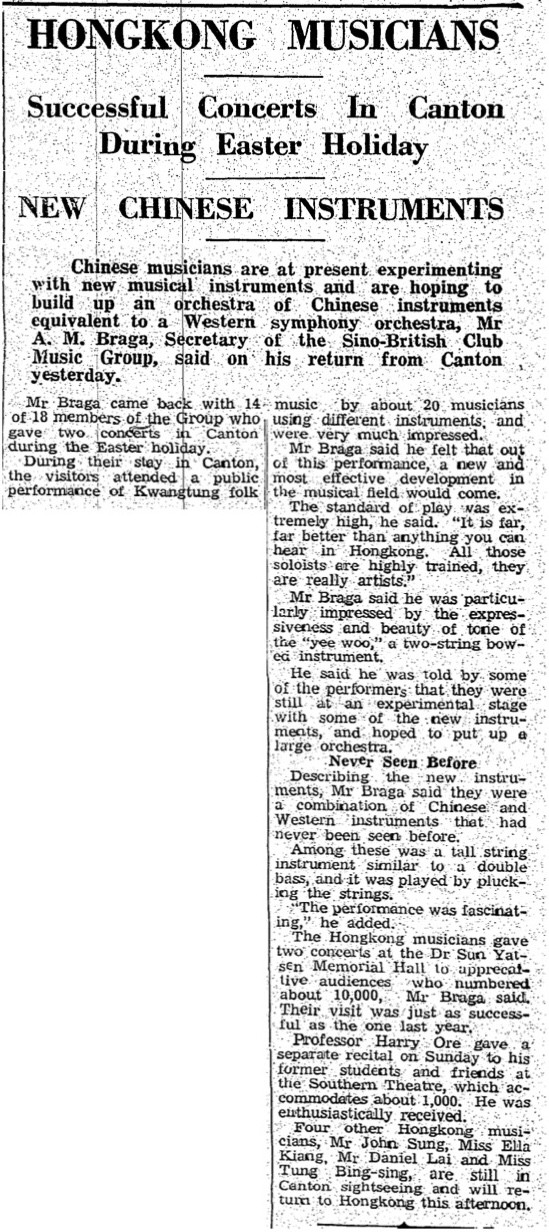
(Source: South China Morning Post, Apr 23, 1957.)
- Hong Kong had such a hall
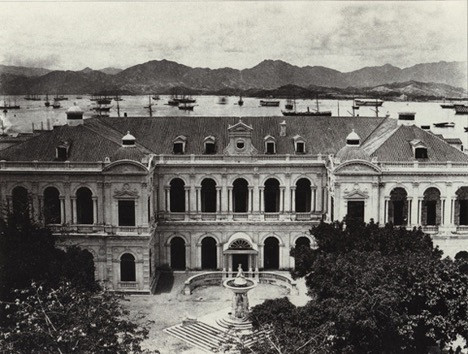
(Source: Public domain. Please contact us if any copyright issue.)
- creating Chinese orchestras more like western ones
Probably the best known of these was the Datong yinyue hui” (great harmony music society, 大同音樂會) established in Shanghai in the 1920s. They were supposed to perform at the 1933 Chicago World’s Fair, but couldn’t raise enough money to go, and sent a recording instead; it appears to have been lost. Here’s a picture of them: 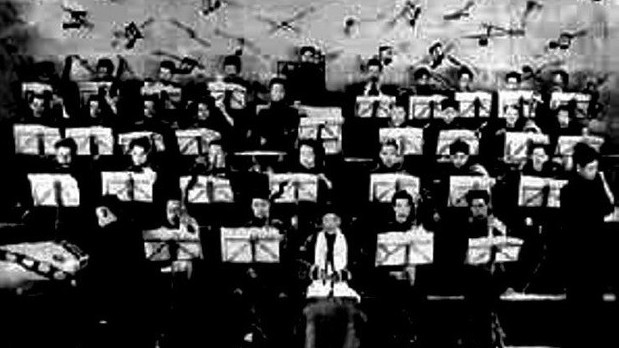
(Source: Xuruhui. Please contact us if any copyright issue.)
- even dressing the orchestra
The National Orchestra on the mainland wore Mao Zedong jackets and pants. The one in Taiwan wore Western suits and ties, like Western orchestras; so did the Chinese orchestra in Singapore. Not wanting to imitate either of these models, and wanting to affirm a connection to traditional Chinese culture, the HKCO chose a modified version of a Qing dynasty scholar’s gown for men, and a cheongsam (really an early 20th century innovation) for women.
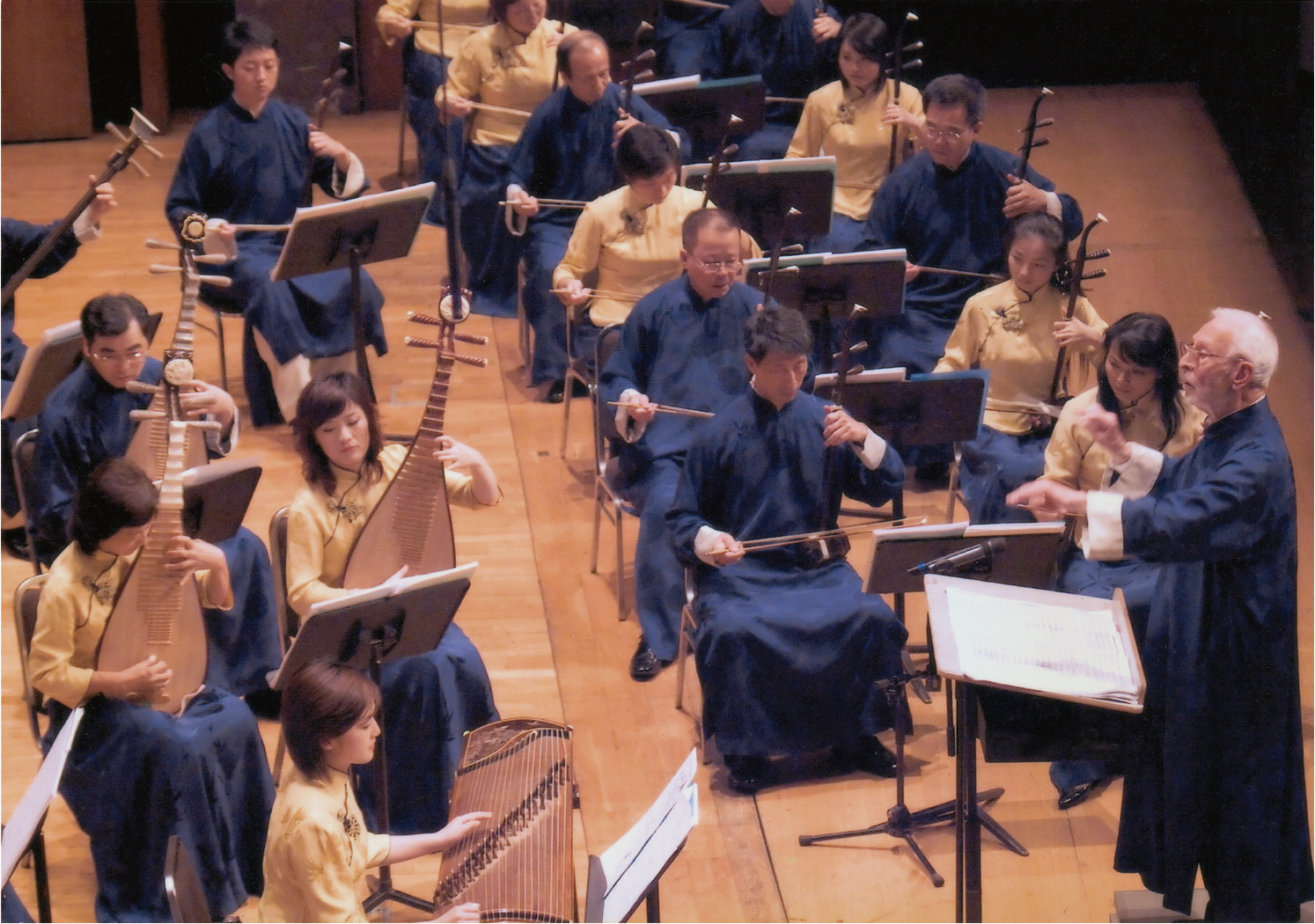
(Source: The image originally appeared in Light and Shade: Sketches from an Uncommon Life. Copyrights © 2009 by Hong Kong University Press. Reprinted by permission of Hong Kong University Press.)
- creating new instruments
Traditional Chinese instruments were not as standardized as western ones. The violin that an orchestra would use in New York and the one that an orchestra would use in Berlin are the same (unless it’s a concert designed for old instruments), but a huqin in Shanghai would not necessarily be the same as one in Chengdu. Nor would it necessarily sound the same, raising problems for the use in one place of scores written for performance elsewhere. Moreover, modern Chinese orchestras that wanted to play adaptations of western music found that traditional Chinese instruments could not do certain things. For instance, Western string instruments rely on the air vibrating within a hollow chamber inside the instrument for their sound: big instruments with a big hollow sound can produce very low pitches, as on a cello or double bass. However, traditional Chinese string instruments did not rely on a hollow chamber behind the strings, but on a membrane made from an animal skin – usually a snakeskin. Limits on the size of available snakeskin pieces therefore limited how low a sound a string instrument could make, and there simply was no traditional Chinese string instrument that could produce a sound like those of a cello or bass. By the mid-20th century, however, there were artificial fabrics that could produce the right sounds, and be made in pieces as big as one wanted; the HKCO was a pioneer in creating string instruments using these fabrics, which allow for low-sounding strings, and are now used by many other Chinese ensembles. As a bonus, since these fabrics do not come from animal skins, some people feel that they represent a more humane approach to instrument-making. At first, some people felt that instruments made with the new fabrics did not sound as good as the old ones, but they have now improved and are widely accepted – some people feel they sound better (which was apparently Bard’s opinion).
- POW camp
In an oral history he provided years later, Bard describes his role providing care in the POW camp as requiring many non-medical skills: figuring out when patients really needed to be excused from labor, and when he should not risk his credibility by saying they were too sick to work; dealing with the camp’s black marketeers to get eggs or other healthy food for the people who most needed it; and doing what he could to keep up morale. (He mentions that some of the black marketers were really very helpful, and even got him some necessary supplies for free – usually by trading cigarettes. He also mentions the morale problems caused in the early months by depression among soldiers who had believed the rumors that Nationalist Chinese soldiers were on their way to liberate Hong Kong, and became demoralized when they realized that they had been lied to about this.) Other aspects of the work were medical, but not covered by any of his training: if he did not have enough of a needed medicine, should he give everyone who needed it a weak dose, or the patients who needed it most a full dose? Some of it also involved treating diseases Bard was not used to seeing, but which appeared in camp because of malnutrition and/or people who had missed vaccinations.